Loading
Admin · Partial
PartialTrack warranty claims without a shoebox of PDFs
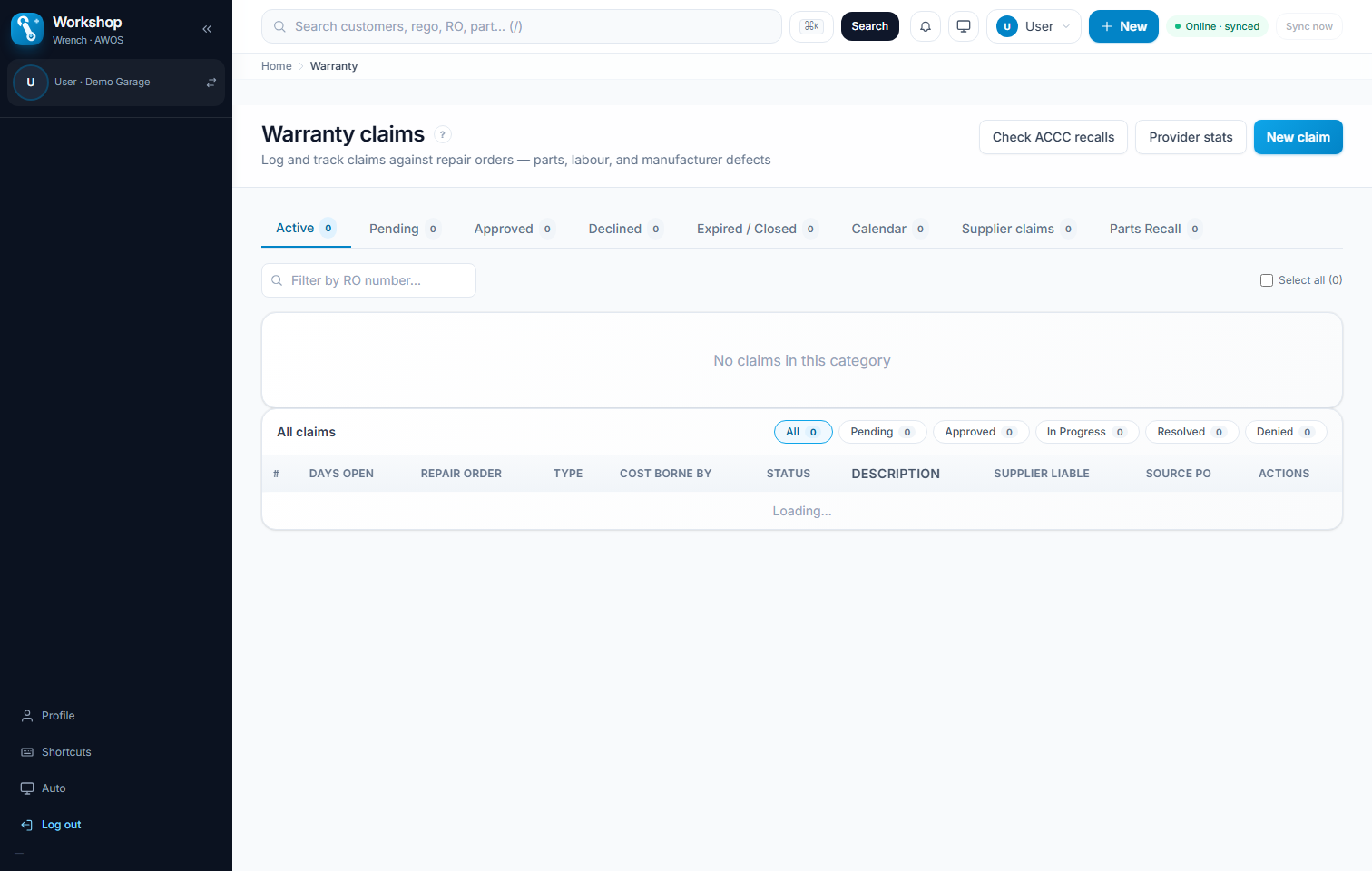
Warranty work needs status and history even when insurers are still email-driven. Workshop Wrench provides a warranty claims entity and UI as a Partial shell — not a live insurer integration.
Primary persona: Advisor / admin
The problem
What breaks without this process
Warranty jobs stall because status lives in email threads nobody owns.
Why it matters
Rationale — profit, risk, and shop floor truth
- 01
OPEN → SUBMITTED-style transitions create accountability.
- 02
Ties claim context back to vehicle/customer history.
- 03
Honest Partial avoids promising insurer APIs that do not exist yet.
Proof from the live demo
Real UI — not a pitch mockup
Captured from the seeded multi-tenant demo. Open the same surface with demo credentials.
live demo capture
Stage sequence
Step-by-step use case
Each stage lists the action, the business why, and the intended outcome. This is how we implement and test the product — not marketing fiction.
- 01
Open claim
Action
Create warranty claim linked to context available in demo.
Why this stage
Work starts as a tracked object.
Surface: /warrantyOutcome: Claim # - 02
Advance status
Action
Move claim through allowed statuses.
Why this stage
Queue visibility for office staff.
Surface: /warrantyOutcome: Status audit - 03
Close or hand off
Action
Complete shop-side tracking; external insurer still manual.
Why this stage
No fake Connected insurer logos.
Surface: /warrantyOutcome: Honest closure
Related search intent
- warranty claims workshop software
- auto repair warranty tracking